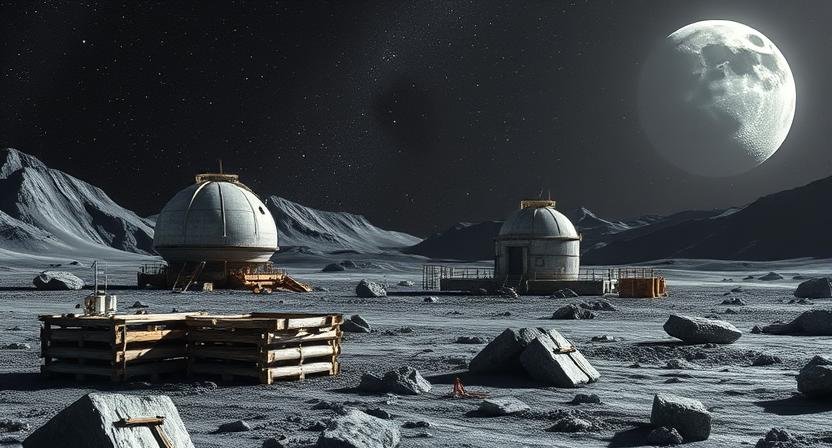
Imagine building a city in the most desolate, unforgiving environment you can conceive. That’s essentially the monumental task facing engineers and scientists as they design the Energy & Power Infrastructure for Lunar Bases. It's not just about flipping a switch; it's about engineering resilient, robust systems capable of powering humanity's next giant leap—from scientific outposts to future settlements.
The Moon, our closest celestial neighbor, beckons with immense potential for discovery and resource utilization. Yet, establishing a permanent human presence demands a constant, reliable energy supply that can withstand extremes. Without it, everything else, from life support to scientific instruments and resource extraction, grinds to a halt. This isn't merely an engineering problem; it’s a foundational challenge defining the future of space exploration.
At a Glance: Powering the Lunar Future
- The Lunar Environment is Brutal: Extreme temperatures, vacuum, and radiation demand highly durable and innovative power solutions.
- A Blend of Technologies is Key: No single power source can meet all lunar base needs; a combination of solar, nuclear, and chemical systems is essential.
- Solar Power is a Baseline: Photovoltaic and solar thermal systems are vital, but lunar nights and dust pose significant challenges.
- Nuclear Power Offers Resilience: Radioisotope Thermoelectric Generators (RTGs) provide constant, low power; nuclear fission power offers high, continuous power for larger bases.
- Storage and Distribution are Crucial: Batteries, fuel cells, and smart microgrids are necessary to manage power fluctuations and long lunar nights.
- Lunar Resources (ISRU) are a Game-Changer: Utilizing local materials for fuel or building can dramatically reduce reliance on Earth.
- Phased Development is the Path: Lunar power systems will evolve, starting small and scaling up with base expansion and technological maturity.
The Moon's Power Problem: More Than Just a Dark Side
The allure of the Moon is undeniable. It's a strategic launchpad for deeper space missions, a treasure trove of scientific data, and potentially a source of valuable resources like water ice and helium-3. But building a sustainable presence there means confronting an environment that actively tries to break anything humans send its way.
The lunar environment is unforgiving. Temperatures swing wildly, from blistering daytime highs around 120°C (248°F) to frigid nighttime lows of -170°C (-274°F). There's no atmosphere to speak of, leaving everything exposed to vacuum and a relentless barrage of solar and cosmic radiation. Then there’s the dust — a fine, abrasive, electrostatically charged powder that clings to everything, degrading equipment and blocking solar panels. These conditions aren't just an inconvenience; they are fundamental design constraints that demand revolutionary approaches to energy systems, as noted by space-axiom.com.
Thankfully, we're not starting from scratch. Decades of lunar exploration, from NASA’s Apollo missions to China's Chang'E program, have provided invaluable data. These historical endeavors taught us about lunar regolith, radiation effects, and the basic requirements for operating in such a hostile domain, paving the way for the next generation of lunar technology. We’re building on a rich foundation of hard-won knowledge.
Core Power Systems: A Toolbox for the Lunar Frontier
Just as a carpenter needs more than just a hammer, a lunar base requires a diverse suite of power technologies. Each system has its strengths and weaknesses, making a multi-faceted approach the most viable path to a robust and sustainable energy infrastructure. Space-axiom.com highlights a range of promising systems, which we’ll dive into.
Solar Power: Harnessing the Lunar Sun
Solar energy is often the first thought for space power, and for good reason—the Moon is bathed in sunlight for much of its cycle.
Photovoltaic (PV) Arrays: The Sun's Electric Harvest
These are your familiar solar panels, converting sunlight directly into electricity. They are a workhorse for early lunar outposts due to their proven technology and relative simplicity.
- Advantages: Well-understood technology, scalable, no moving parts (mostly), abundant resource during lunar day.
- Challenges:
- Lunar Night: With periods lasting about 14 Earth days, PV arrays go completely dark. This necessitates massive energy storage solutions.
- Dust Accumulation: Electrostatic lunar dust can coat panels, dramatically reducing efficiency. Active cleaning mechanisms (e.g., electrostatic dust repellents, robotic brushes) are critical.
- Radiation Degradation: Long-term exposure to solar and cosmic radiation can damage solar cells, reducing their lifespan and output.
- Thermal Management: The extreme temperature swings can stress materials and electronics.
Solar Thermal Technology: Direct Heat from the Sun
Instead of converting light to electricity, solar thermal systems focus sunlight to generate heat. This heat can then be used directly for habitation, industrial processes, or to drive a Stirling engine for electricity generation.
- Advantages: Efficient at generating heat, which is useful for In-Situ Resource Utilization (ISRU) processes like extracting water from regolith, or for habitat heating. Can also be paired with thermal energy storage.
- Challenges: Requires precise tracking of the sun, susceptible to dust accumulation on mirrors, can be complex to deploy and maintain.
Nuclear Power: The Steadfast Heartbeat
For continuous power, especially during the long lunar night or for locations in shadowed craters, nuclear technologies are indispensable.
Radioisotope Thermoelectric Generators (RTGs): Reliable Niche Power
RTGs generate electricity from the heat produced by the natural decay of radioactive isotopes (like Plutonium-238). They have a long heritage, powering everything from Apollo lunar surface experiments to Voyager probes and the Perseverance Mars rover.
- Advantages: Extremely reliable, long operational lifespan (decades), compact, provides constant power independent of sunlight or orientation, robust in harsh environments.
- Challenges: Low power output (typically tens to hundreds of watts), expensive, uses radioactive materials (requiring stringent safety protocols), limited fuel supply.
- Best Use: Ideal for remote sensors, small rovers, or foundational power for initial outposts before larger systems are deployed.
Nuclear Fission Power: High-Capacity and Continuous
This is where the real muscle comes in for larger, more complex lunar bases. Small modular reactors (SMRs) or microreactors, often referred to as fission surface power (FSP) systems, offer continuous, high-density power. NASA has been actively developing concepts for such reactors, aiming for power levels in the 10-40 kW range initially, with scalability to megawatts.
- Advantages: High power output (kilowatts to megawatts), operates independently of sunlight, provides continuous baseload power, long operational life once deployed.
- Challenges:
- Deployment Complexity: Requires complex assembly and commissioning on the lunar surface.
- Safety & Shielding: Needs robust radiation shielding for crew and sensitive equipment, which adds mass.
- Regulatory Hurdles: International treaties and Earth-based regulations for nuclear materials are stringent.
- Thermal Management: Needs effective heat rejection systems in a vacuum.
- Best Use: Powering large habitats, advanced ISRU operations, scientific labs, and industrial facilities. This is a crucial component for long-term lunar settlement.
Nuclear Fusion Power: The Distant Dream
While still largely theoretical for space applications, nuclear fusion – the process that powers the sun – represents the ultimate clean, high-density energy source. Harvesting helium-3, a rare isotope found in lunar regolith, could theoretically fuel fusion reactors.
- Advantages: Extremely high energy yield, minimal radioactive waste (compared to fission), potential for abundant lunar fuel.
- Challenges: Fusion technology is still decades away from commercial viability on Earth, let alone deployment on the Moon. It represents a very long-term goal.
Chemical & Electrostatic Solutions: Supporting Roles
Beyond the primary power generators, other technologies play vital supporting roles.
Fuel Cells: Energy Storage and Lifecycle Support
Fuel cells convert chemical energy into electrical energy, often using hydrogen and oxygen to produce electricity and water. Regenerative fuel cells (RFCs) can also run in reverse, using electricity to split water back into hydrogen and oxygen for storage.
- Advantages: Efficient energy storage, produces water (a valuable resource), can store large amounts of energy, faster recharge/refuel than batteries for certain applications.
- Challenges: Requires a constant supply of fuel (H2 and O2), complex system with various subsystems (tanks, pumps).
- Best Use: Crucial for storing energy through the lunar night, providing power for rovers, and linking to ISRU processes that produce water.
Electrostatic Power Systems: A Niche Technology
Space-axiom.com mentions electrostatic power systems as one of the 8 promising options. These systems typically generate power through the movement of charged particles in an electric field. While less mature for large-scale lunar base power compared to solar or nuclear, they might offer niche applications in specific conditions, perhaps for dust mitigation or low-power sensing. Further research and development are needed to define their role more clearly in a lunar context.
Beyond the Core: Making Lunar Power Sustainable
Generating power is only half the battle. To create a truly sustainable lunar base, you need robust ways to store that power, distribute it efficiently, and integrate it with local resources.
Energy Storage: The Lunar Battery Pack
Given the 14-day lunar night, energy storage isn't just a nice-to-have; it's existential.
- Batteries: Lithium-ion batteries, similar to those used in electric vehicles, are a primary choice for short-term storage and load balancing. They are mature and reliable but suffer from degradation over many charge cycles and extreme temperatures. Advanced solid-state or high-temperature batteries are under development for better lunar performance.
- Regenerative Fuel Cells (RFCs): As discussed, RFCs are excellent for large-scale, long-duration energy storage. They effectively convert electrical energy into storable chemical energy (hydrogen and oxygen), which can then be converted back to electricity when needed. This is particularly attractive when water is available from ISRU.
- Mechanical Storage: Concepts like flywheels, which store energy as rotational kinetic energy, are being explored. They can offer high power density and longevity but are more complex mechanically.
Distribution Networks: Wiring the Lunar Outpost
A base needs a smart grid, not just a tangled mess of cables. Lunar power distribution systems must be robust, resilient, and adaptive.
- Microgrids: Future lunar bases will likely operate as isolated microgrids. These are self-contained energy systems that can generate, store, and distribute power locally.
- High-Voltage DC (HVDC): Direct current (DC) distribution is generally preferred in space applications to avoid energy losses associated with AC conversion and reactive power. Higher voltages reduce current, minimizing resistive losses over long cables, crucial for extending power to remote assets like ISRU plants.
- Wireless Power Transfer: While nascent, wireless power transfer (e.g., via microwave beams or lasers) could eventually power rovers, remote equipment, or even provide power to shadowed craters from a central solar array.
- Fault Tolerance: The system must be designed to isolate faults quickly, ensuring that a problem in one area doesn't cascade and shut down the entire base.
ISRU Integration: Living Off the Land
The ability to "live off the land" – In-Situ Resource Utilization (ISRU) – is paramount for long-term sustainability. This directly impacts energy infrastructure.
- Water Ice: Extracting water ice from permanently shadowed regions (PSRs) at the poles is a key goal. This water can be processed into potable water, breathable oxygen, and, critically, hydrogen and oxygen propellants for fuel cells or rockets. The energy required for this extraction and processing is substantial, making it a primary driver for high-power systems like fission reactors.
- Regolith Processing: Lunar soil (regolith) contains elements like silicon, iron, and aluminum that could be used for construction or manufacturing. Extracting these often requires high temperatures and significant energy.
- Synergy: Imagine a fission reactor powering a water-ice extraction plant, which in turn feeds hydrogen and oxygen into regenerative fuel cells that provide backup power for the base during night or peak demand. This kind of closed-loop system is the ultimate goal for lunar sustainability.
The Phased Approach: Building Block by Block
You don't just plop a fully functional power grid onto the Moon. Building lunar energy infrastructure will be a phased process, evolving with the base's maturity and operational needs. This strategic integration of multiple systems at different stages is key to creating a comprehensive energy supply framework conducive to sustainable lunar exploration and settlement, as noted by space-axiom.com.
Phase 1: The Outpost – Low Power, High Reliability
- Initial Setup: Small robotic landers and early human outposts will likely rely on small PV arrays during lunar day, backed by powerful batteries and potentially a few RTGs for critical systems or continuous low-power needs. Mobility might use smaller RTGs or battery-powered rovers recharged by PV.
- Focus: Survival, basic scientific operations, proving ground for initial technologies.
Phase 2: Growing Pains – Scaling Up
- Increased Demand: As more habitats, scientific labs, and initial ISRU pilot plants arrive, power demands will increase significantly. This is when larger PV arrays, potentially paired with solar thermal systems for heat, become more prevalent.
- Nuclear Introduction: The deployment of a first small modular nuclear fission reactor (10-40 kW) becomes critical to provide continuous, high-density power for primary life support and industrial processes, especially to support early ISRU operations.
- Enhanced Storage: More robust battery banks and the first regenerative fuel cell systems will come online to manage the longer lunar night cycles and peak loads.
Phase 3: Settlement – Megawatt Scale and Self-Sufficiency
- Major Expansion: A fully fledged base or settlement will require megawatts of power. Multiple fission reactors, expansive solar farms (perhaps even in polar regions with extended sunlight), and interconnected energy storage solutions will form a robust grid.
- Advanced ISRU: Large-scale water extraction, propellant production, and manufacturing capabilities will be integrated, making the base increasingly self-sufficient.
- Redundancy: High levels of redundancy will be built into the system to ensure continuous operation even if components fail. Power sharing between different generation sites becomes crucial.
Overcoming Lunar Obstacles: Design for Resilience
Designing for the Moon means building things that not only work but endure.
- Radiation Hardening: Electronic components must be shielded and designed to resist degradation from constant solar and cosmic radiation. This impacts everything from communication systems to power control units.
- Thermal Management: Components must survive and operate efficiently across the extreme temperature swings. This involves radiators for heat rejection during the day and active heating systems or robust insulation during the brutal night.
- Dust Mitigation: Dust is relentless. Systems need self-cleaning surfaces, robotic cleaners, or even electrostatic dust repulsion technologies to prevent performance degradation on solar panels, radiators, and moving parts.
- Autonomous Operation: Minimizing human intervention is key. Systems must be capable of self-monitoring, diagnostics, repair (to some extent), and intelligent load management to optimize power use and respond to unforeseen events.
- Modularity and Repairability: Components should be designed for easy replacement or repair by robots or astronauts, allowing for maintenance rather than complete system overhauls.
The Human Element: Operating and Maintaining Lunar Power
While automation will be critical, human ingenuity and presence will remain central to the success of lunar power infrastructure.
Robots will likely handle the initial deployment, routine maintenance, and hazardous tasks like dust cleaning or inspecting nuclear facilities. However, astronauts will be crucial for complex repairs, system upgrades, and overseeing the overall energy management strategy. Training for lunar power systems will be highly specialized, focusing on diagnostics, repair, safety protocols for nuclear materials, and efficient resource allocation. Ultimately, the safety of the crew depends directly on a perfectly functioning, resilient power supply.
Charting the Future: From Outpost to Settlement
The development of a robust energy system is a crucial step in humanity's ongoing quest for space exploration. By harnessing a blend of technologies and leveraging historical wisdom, the path to a sustainable lunar future looks more promising than ever, as space-axiom.com concludes.
The roadmap for lunar power is clear: start small, prove technologies, then scale. Research and development will continue to focus on improving efficiency, reducing mass, increasing reliability, and integrating ISRU to reduce reliance on Earth. International collaboration, sharing knowledge and resources, will be vital to accelerate progress and reduce the monumental costs involved. This is a grand engineering challenge, one that will unlock not just a foothold on the Moon, but potentially a new era of space industrialization and exploration.
Your Next Step in the Lunar Journey
Understanding the complexities of energy and power infrastructure is fundamental to grasping the future of lunar exploration. Whether you're an aspiring space engineer, an investor in aerospace, or simply a curious mind, recognizing the challenges and ingenious solutions being developed provides a clearer picture of humanity's lunar destiny. Dive deeper into the opportunities and challenges awaiting humanity on our closest celestial neighbor and Explore our Service Moon hub to learn more about the critical services supporting this ambitious endeavor. The Moon isn't just a destination; it's a testbed for the future of sustainable living beyond Earth.